Kirill Solomonovich Gutnov
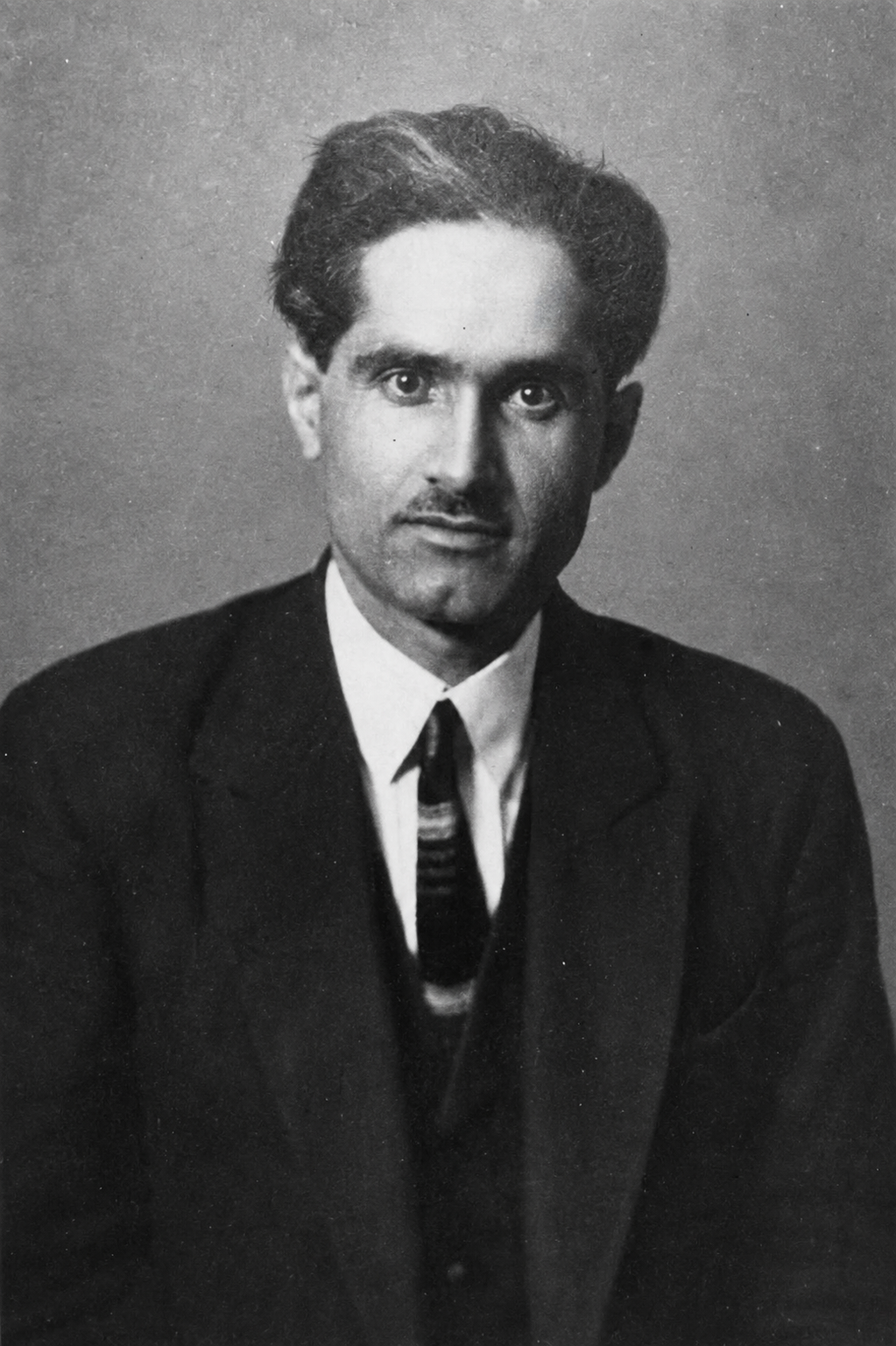
Kirill Solomonovich Gutnov (Ossetian name: Kyltsi, also rendered Kiltsi; 1892–1937) was an Ossetian printing specialist, publishing organiser, and translator of Russian and foreign literature into Ossetian. He helped establish publishing in North Ossetia, represented the Berlin publishing house of his elder brother Eugen Gutnov in Vladikavkaz, and assisted in arranging deliveries of modern printing equipment. In 1937, his correspondence with his brother in Germany became one of the principal grounds for a fabricated accusation of espionage. Kirill Gutnov was executed on 10 December 1937 and posthumously rehabilitated on 24 November 1955.
Childhood and Early Working Life
Kirill was born in 1892 in the village of Dzivgis in the Kurtatinsky Gorge, to Solomon and Gadzi Gutnov. The family had five sons and two daughters; Kirill was the second son, after Eugen. In 1907, Solomon Gutnov moved the family to Vladikavkaz, hoping to give his children the opportunity to obtain an education and a profession. For the first few years, the Gutnovs lived in rented accommodation; later they built a small house on what was then Podgornaya Street, on the outskirts of the city.
Soon after the move, fifteen-year-old Kirill found work as an errand boy in a dry-goods shop. He gradually learned the trade and by 1917 had risen to the position of shop assistant. After the Revolution, influenced by his elder brother Eugen, Kirill left commerce and devoted his working life to printing. He began as a typesetter, mastered the printer’s trade, and eventually became a qualified printing specialist.
Evgenia Vladimirovna Gutnova, the wife of Kirill’s younger brother Elbrus, remembered him as a handsome, charming, and exceptionally noble man. According to her memoirs, he was a communist devoted to the ideals of the Revolution and held an important position in the publishing and printing world of Ordzhonikidze. At the time of his arrest, Kirill was working as a proofreader at the printing house of the Ossetian National Publishing House. E. V. Gutnova, “Second Love: My Husband Elbrus Gutnov”
Family
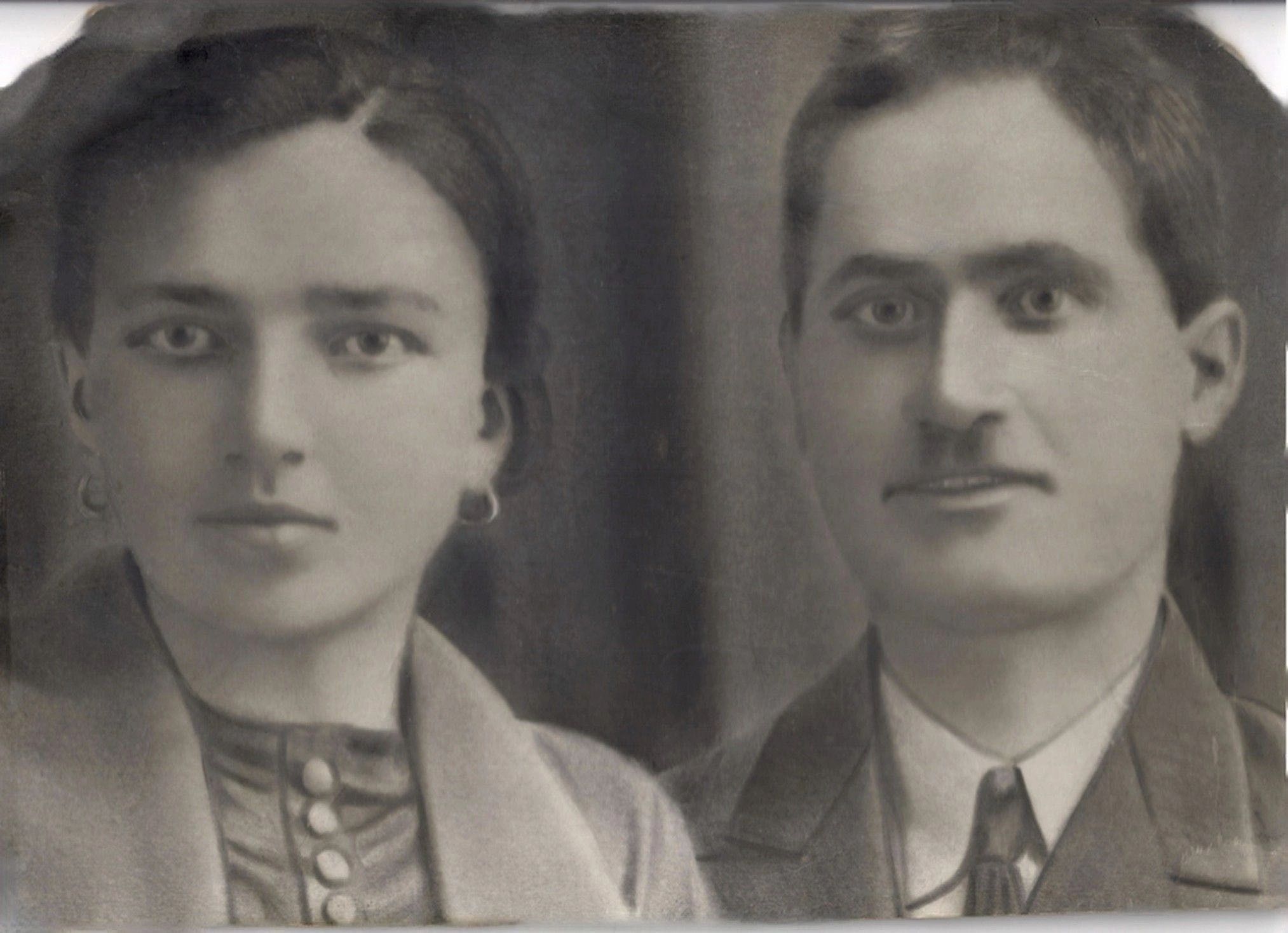
Kirill was married to Ekaterina Timofeyevna Gutnova. They raised three children: their eldest daughter Alexandra, known in the family as Fuza; their son Alexander; and their youngest daughter Zefira, born in 1926.
Zefira remembered her father as a gentle, kind, cheerful, and open man. He loved children, knew a great deal, and had a gift for awakening their interest in books and the world around them. It was he who instilled in Zefira a love of reading. He had a beautiful voice, sang, and played Ossetian melodies on the balalaika. After his arrest, his daughter often wept over the instrument he had left behind.
Zefira preserved many memories of everyday life with her father. When she was little, she would wait for him in the street after work, throw her arms around his neck, and Kirill would carry her home. In “A Piece of Churek,” she recalled losing a piece of hot bread that had unexpectedly come into her hands during a time of hunger. Her father did not scold her; he merely called her a silly little girl with affection and, as always, carried her home in his arms — crying this time.
During the hungry 1930s, Kirill and Ekaterina spent every weekend working in the fields of an experimental farm outside the city. In the autumn they were paid for their labour with an entire cartload of maize. Zefira remembered that winter as the most plentiful of her childhood. Another of her stories, “Looking for Potatoes,” recounts how Kirill and his twelve-year-old son Alexander spent a whole day gathering potatoes left after the harvest, only to have a watchman confiscate everything they had collected. Kirill came home humiliated and dejected and played the balalaika for a long time.
Publishing Work and Cooperation with Eugen Gutnov
Kirill’s elder brother Eugen Gutnov lived in Berlin and owned a printing house that published Russian and Ossetian literature. Between 1922 and 1925 he published and sent eleven print runs of books to North Ossetia, including works by Kosta Khetagurov, Georgiy Maliev, Andrey Guluyev, Tsomak Gadiyev, Tsotsko Ambalov, Schiller, and Korolenko. At the same time, Eugen helped Soviet printing houses acquire Linotype machines, typefaces, and other modern printing equipment.
Kirill was the link between the Berlin publishing house and North Ossetia. Eugen called him his authorised representative and entrusted him with distributing the books printed in Berlin. The final page of one Ossetian edition identified Kirill as the head of the Vladikavkaz agency and a seller of Russian-language books. It also gave the address: 23 Podgornaya Street, Vladikavkaz. This publishing address was also the Gutnov family home. Study by Vittorio Springfield Tomelleri
According to Zefira’s memoirs, Kirill travelled to Berlin in 1924 to collect a Linotype machine. Felix Gutnov adds that Kirill visited his elder brother, trained on the new equipment, and accompanied shipments of printing machinery to Russia. In 1927, Eugen himself visited Vladikavkaz to deal with organisational matters connected with these deliveries. Kirill’s role was therefore not limited to receiving parcels and selling books: he acted as an intermediary between the Berlin publisher and the printing enterprises of North Ossetia. Felix Gutnov, “The Gutnovs”
The surviving letters show that by 1931 Kirill was already performing managerial duties at the publishing house and printing works associated with the newspaper Ræstdzinad. Eugen gave him detailed advice on organising the printing shops, preparing manuscripts, reducing the expense of resetting type, working with authors, and distributing newspapers and books. He encouraged his brother to trust his own experience and considered him an excellent authority on the Ossetian language.
In the autumn of 1931, Kirill was sent to Moscow for further training. The correspondence shows that he began studying accounting, although Eugen advised him to enrol in the Red Directors’ Courses and concentrate on the practical management of a printing enterprise. The surviving materials do not establish whether Kirill completed these courses. By 1937 he no longer held a managerial post and was working as a proofreader.
Translations into Ossetian
Alongside his printing work, Kirill translated Russian and foreign children’s literature into Ossetian. At least four books translated by him are known.
The following were published in Vladikavkaz in 1931:
- Anton Chekhov’s story Kashtanka;
- Bodström’s How the She-Wolf Lived in the World;
- Zamchalov’s To the Melon Field.
In 1935, Kirill’s translation of Rudyard Kipling’s Rikki-Tikki-Tavi was published.
The 1931 edition of Kashtanka was one of the earliest separate editions of Chekhov in Ossetian. Publications on Ossetian translations of Chekhov identify Kirill by his Ossetian name, Kyltsi or Kiltsi Gutnov. An excerpt from his translation is preserved in the online collection of the National Scientific Library of North Ossetia. The publication of the book in 1931 is also confirmed by the article “Chekhov for Two Ossetias”.
Zefira particularly remembered her father’s translation of Rikki-Tikki-Tavi. Kipling’s book was reissued in Ossetian in 1958, but the translator was not named on the title page. After comparing the two editions, Zefira concluded that the reprint was based on Kirill’s translation: the texts were identical apart from minor editorial changes. His work thus continued to circulate even though the reissued book omitted the repressed translator’s name.
The Correspondence Used as “Evidence”
Kirill and Eugen maintained an extensive correspondence at least until May 1935. They discussed printing-house operations, the preparation and distribution of publications, printing equipment, Kirill’s courses in Moscow, and family affairs. Eugen’s letters were later placed in Kirill’s investigative file and declared “material evidence.”
During the search, NKVD officers confiscated objects connected with Germany: a gramophone and album of postcards brought by Eugen, as well as a typewriter — one of the most valuable objects in the house. The investigators sought hidden meanings in ordinary professional correspondence. Even Eugen’s use of the words “organisation,” concerning the work of the printing house, and “theory,” which Kirill was to study on his courses, was marked as suspicious. The correspondence between two printing specialists was interpreted as the transmission to Germany of information about printing houses and publishing organisations in North Ossetia.
The letters were later preserved in the archives of the KGB of the North Ossetian ASSR and subsequently transferred to the Central Republican Archive. In 1991, Zefira Butaeva published part of the correspondence, together with a detailed introduction, in the journal Daryal under the title “An Ossetian Publisher from Berlin.” Bibliographic record of the publication
Arrest and Execution
Kirill Gutnov was arrested at his home in Vladikavkaz on the night of 28 October 1937. Zefira, then eleven years old, awoke to the noise and saw her father sitting beside her bed, pulling on his socks with trembling hands. Men in military uniform were walking around the room. They then led Kirill away, and his family never saw him again.
Kirill was accused of belonging to a “counter-revolutionary, bourgeois-nationalist, espionage, insurgent organisation,” conducting anti-Soviet propaganda, and carrying out intelligence work for Germany. His case was joined with those of other residents of North Ossetia who were declared members of a supposed “People’s Party.” The indictment was drawn up by NKVD officer V. A. Boyarsky.
On 7 December 1937, a troika of the NKVD of the North Ossetian ASSR sentenced Kirill Gutnov to death. The sentence was carried out at 8 p.m. on 10 December 1937. His burial place remains unknown. The Book of Remembrance identifies him as a native of Dzivgis and an employee of the printing house of the Ossetian National Publishing House. Entry in the Book of Remembrance of Victims of Political Repression in North Ossetia
A later review of the case established that the bourgeois-nationalist insurgent organisation named in the indictment had never existed in North Ossetia and that the case had been fabricated. No evidence of espionage by Kirill was found.
Decades of Deception
For many years after the arrest, the family did not know what had happened to Kirill. At first, officials accepted two parcels from Ekaterina; in December they told her that the prisoner had “departed.” His relatives assumed that he had been sent to a labour camp. For the rest of her life, Ekaterina Timofeyevna reproached herself for failing to give her husband warm underwear, unaware that he had already been executed.
In 1940, Zefira was told that her father had supposedly been sentenced to ten years “without the right of correspondence.” In 1947 she was informed that he had died in a camp in 1942. The family was later issued a certificate stating that Kirill had died of lobar pneumonia on 23 December 1943. This fictitious date still appears in some archival descriptions compiled from the family’s original documents.
Kirill Gutnov was rehabilitated on 24 November 1955. Even then, however, the family was not told the whole truth: the certificate issued by the Supreme Court of the North Ossetian ASSR merely stated that the case of the man convicted by the former NKVD troika had been closed. Digital archive of the Memorial Research and Information Centre
Only in 1989 was Zefira told orally that her father had been executed by order of the troika. She later gained access to the investigative file: the arrest warrant, inventory of confiscated property, interrogation records, indictment, and certificate confirming that the sentence had been carried out. In 1991, the family finally received an accurate death certificate bearing the date 10 December 1937.
The Family after the Arrest
After Kirill’s arrest, Ekaterina Timofeyevna was left to support her eighty-year-old father-in-law Solomon, her school-age son Alexander, and eleven-year-old Zefira; the eldest daughter, Alexandra, was already married. Ekaterina tried to find work at the printing house where she had once worked in the bindery and where her husband had been employed until his arrest, but she was refused. She had to work first as a dishwasher in a canteen and later as an unskilled labourer at a canning factory.
Kirill’s son Alexander refused publicly to renounce his father as an “enemy of the people” and was expelled from the Komsomol. During the Second World War he served in the Red Army, was awarded the Order of the Red Star, and died in 1944.
Kirill’s father, Solomon Gutnov, changed markedly after his son’s arrest: he became stooped and silent and almost never left the house. He called Kirill the gentlest and kindest of his sons.
Remembrance
Kirill Gutnov’s work encompassed several important fields: practical work in a printing house, the management of publishing production, the distribution of Ossetian books, the introduction of modern printing equipment, and the translation of literature into his native language.
His translations introduced Ossetian children to Chekhov and Kipling, while his cooperation with Eugen helped bring books, typefaces, and printing machinery to North Ossetia. In 1937, correspondence documenting the brothers’ many years of work for Ossetian publishing was turned by investigators into evidence of a nonexistent crime.
Kirill’s daughter Zefira Butaeva devoted herself to preserving his memory. Thanks to her persistence, the circumstances of her father’s arrest and death were uncovered and Eugen Gutnov’s letters were published.
An Excerpt from the Ossetian Translation of Kashtanka
Каштанкæ
Такс æмæ хумæтæджы куыдз, лæбпын, сырхбын – бæкæсгæйæ рувасы хæрз æнгæс, куыдз ратæх-батæх кодта тротуарыл куы размæ, куы фæстæмæ, æмæ тарстхузæй алырдæм касти. Хадтæй-хадт-иу фæлæуыд æмæ-иу, ниугæйæ, сыд къæхтæй, куы иу, куы иннæ фæзил кæнгæйæ, хъавыди йæхицæн дзуапп дæдтынмæ: цымæ куыд æгъдауæй рарæдыдаин ардæм?
Каштанкæ тынг хорз хъуыды кодта, йæ бон куыд арвыста æмæ, фæстагмæ, ацы æнæзонгæ тротуармæ куыд æрбафтыд, уый. Бон райдыдта уымæй, æмæ Каштанкæйы хицау – стъолтæаразæг Александры фырт Лука, худ йæ сæрыл æркодта, йæ дæларм иу хъæдын цыдæр сырх кæлмæрзæны тыхтæй акодта æмæ фæдзырдта:
— Каштанкæ, цом!..
К. Гутнов
Source: National Scientific Library of the Republic of North Ossetia–Alania
Read next: Elbrus Gutnov