THE GUTNOVS

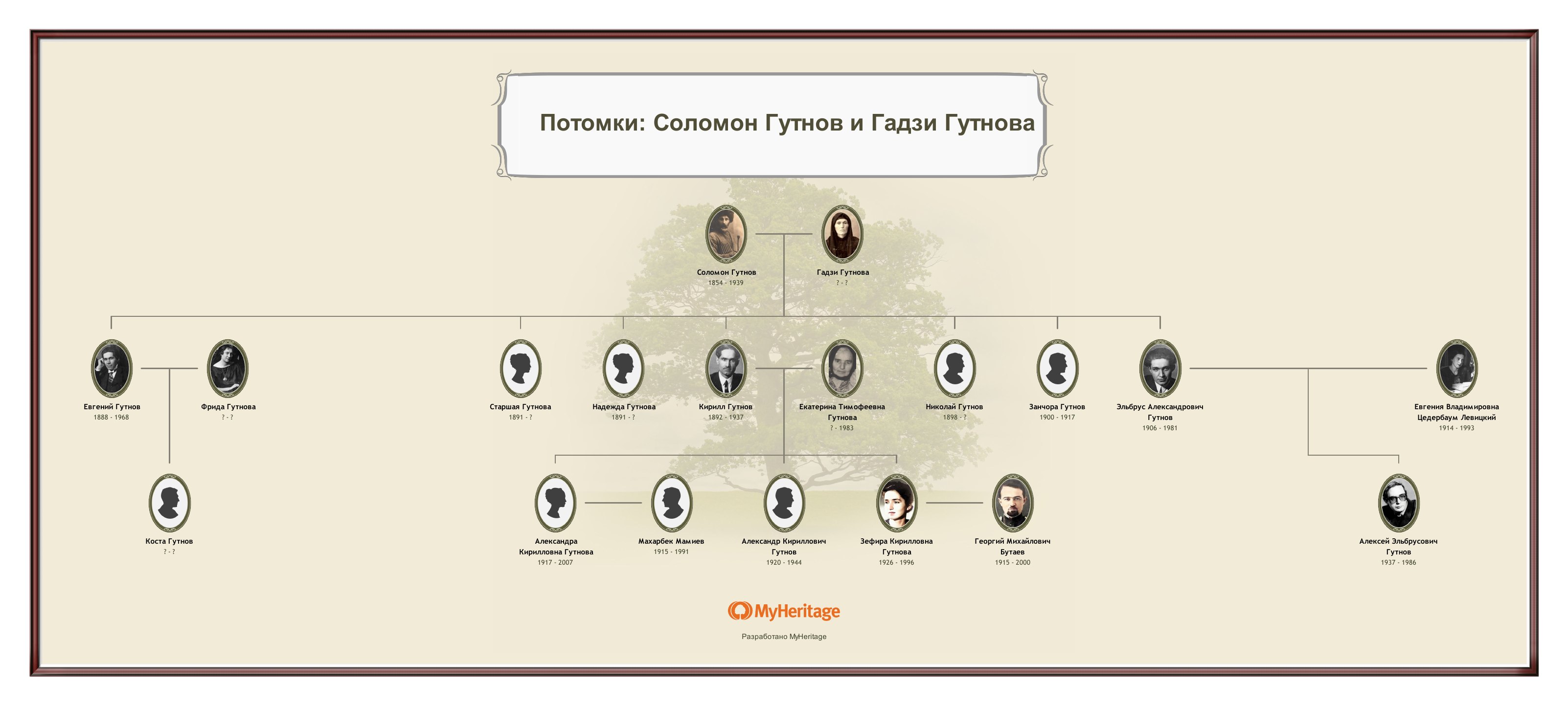
This section brings together interesting materials and links about Zefira Butaeva's grandfather, Kirill Solomonovich Gutnov, his family, and his descendants.

Family Tree

Download PDF

Solomon Gutnov

Solomon Gutnov, 1854-1939

Solomon Gutnov was born in 1854 into the family of Misirbi Gutnov.

He was born and lived in Dzivgis until 1907, when he and his family moved to an apartment in Vladikavkaz. A few years later they built a small house on the outskirts of Vladikavkaz (on the former Podgornaya Street, opposite the school).

Solomon and Gadzi had five sons and two daughters.

The eldest, Eugen Gutnov (Ossetian: Elbyzdyko Gutnov; known in Germany as Eugen Gutnoff), lived in Vladikavkaz, then in St. Petersburg, and in 1912 left for Germany and settled in Berlin.

The second son was Kirill Gutnov (Kylci Gutnov). Right after arriving in Vladikavkaz he took a job as a delivery boy at a dry-goods shop, rising to shop assistant by the time of the revolution. After the revolution, influenced by Eugen, his father went to work at a printing house. He started as a typesetter and, by the time of his arrest in 1937, was a proofreader there.

The third son, Nikolai Gutnov (Nogi Gutnov), worked as a cobbler his whole life.

The fourth, Zanchora Gutnov, was killed by a stray bullet at the age of 17 during the Civil War, while walking down the street.

The youngest, Elbrus, left for Berlin to join Eugen in 1922, enrolled in an arts and crafts school, and later in the graphic arts department of a higher art school. In late 1927 he returned to the USSR and began working in Moscow. Elbrus's biography is covered in Evgenia Gutnova's memoir "Perezhitoye" ("What I Lived Through"); the correspondence between Eugen and Elbrus was published by Dmitry Gutnov in "Bibliophile News No. 17."

In his old age Solomon Gutnov served as an elder of the Vladimirskaya settlement. Thanks to his wisdom he often helped resolve family disputes. He was frequently invited to sit at the head of the table at family celebrations, wakes, and weddings.

Zefira Butaeva tells the story of Solomon Gutnov's family in the story "Grandfather."

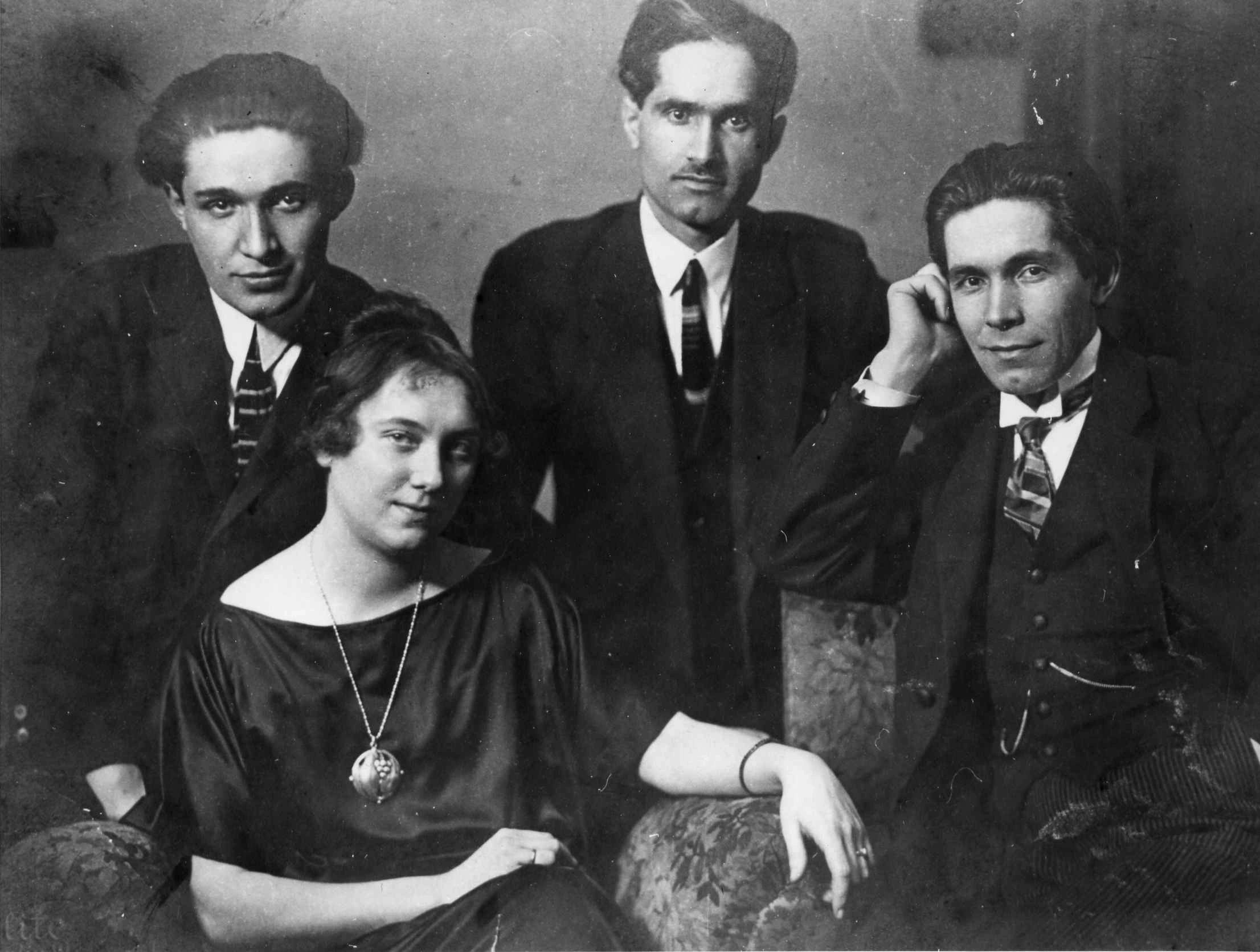
The Gutnov Brothers

Left to right: Elbrus Gutnov, Frida Gutnova, Kirill Gutnov, Eugen Gutnov.

Zefira Butaeva tells the story of Eugen Gutnov, Kirill Gutnov, and Elbrus Gutnov in the story "The Brothers' Tragedy." In 1991 their story was published in Daryal magazine, 1991, No. 3, "An Ossetian Publisher from Berlin."

Kirill and Ekaterina Gutnov

Ekaterina Timofeyevna Gutnova, Kirill Solomonovich Gutnov, 1929.

Alexander Kirillovich Gutnov

Alexander Kirillovich Gutnov was born in 1920 in Vladikavkaz, into the family of Kirill Solomonovich Gutnov and Ekaterina Timofeyevna Gutnova.

He graduated from School No. 16 in Vladikavkaz and went on to higher education at an institute. He loved reading and the theatre, and took part in productions of the drama club.

In 1942, at the age of 20, he was drafted into the Red Army, where he served as a medical instructor of the 25th Cavalry Regiment, 11th Guards Airborne Cossack Cavalry Division, 5th Guards Don Cossack Cavalry Corps, Northern Group of Forces of the Transcaucasian Front.

He fought near Rostov in April-May 1942. He drowned on 25 August 1944 at the age of 24. He is buried at the Russian cemetery in the city of Yevpatoria.

In December 1942, during fighting in the Korgov-Kizilov area, serving as a submachine gunner, he killed eight enemy soldiers. For his steadfastness and courage he was awarded the Order of the Red Star.

Zefira Butaeva tells the story of Alexander Gutnov in the story "No One Is Forgotten."

The Gutnovs (Gutnatæ)

Anyone visiting Dzivgis for the first time is struck by the aul's harsh surrounding nature and its wealth of medieval architectural monuments, especially the cliff fortress. Even a brief glance at these monuments is enough to recognise that warriors once lived here, controlling the entrance to the Kurtatinsky gorge. This is confirmed both by the historical legends of the Kurtatians and by the genealogical accounts of the fortress-aul's residents. The genealogy of the Gutnovs offers a good example.

As far as is known, the first written version of this family's genealogy was compiled by Karase Gutnov on 26 January 1860 for the Vladikavkaz District Estate and Land Commission. Its opening passage is of particular interest: "Our ancestors, as we know from oral tradition, lived in Dzivgis before Kurta, the ancestor of the Kurtatian families, settled in the gorge." No exact date is given; it can only be reconstructed approximately from indirect evidence. In particular, the genealogy mentions the building of a church in Dzivgis "in the 12th century, by Queen Tamar." A comprehensive survey of the church, the cemetery, and the cult monuments narrows down the approximate founding date of the aul — archaeologists suggest that Dzivgis was founded in the 13th century by lowland Alans pushed into the mountains by the Tatar-Mongols. Nearby was an economic base — the Faskau meadow (11 hectares), sheltered from the wind by the mountains. Traces of an irrigation canal about 200 metres long have survived well — the only evidence found in the mountains of irrigated farming.

The Gutnov genealogy also records land ownership: "...from the very beginning of our settlement in mountainous Kurtatia, the village of Dzivgis had its own land and forest." Archival sources from the second half of the 19th century confirm this. For example, Safar Gutnov owned a stone house, a water mill with a capacity of 1 measure (=24 kg) per day, a ploughed plot, a horse, 8 head of cattle, and 45 sheep; Saukudz Gutnov likewise owned a stone house, a mill with a capacity of 5 measures, a ploughed plot, two hay meadows near Dzivgis yielding 80 stacks, 7 head of cattle, and 160 sheep; Magomet Gutnov owned a stone house, a water mill producing 2 measures a day, a ploughed plot, a hayfield yielding 40 stacks, 8 head of cattle and 140 sheep, and so on.

Dzivgis thus defended the entire Kurtatian community from incursions from the plain. It is reasonable to assume that the residents of the fortress-aul were not only farmers but also skilled warriors. Dzivgis may have been one of the centres of the Alan principalities of the Golden Horde period, a kind of border fortress with a garrison of experienced fighters. They had to face the hordes of the famous Timur (Tamerlane).

Chroniclers of the great conqueror left records of the stubborn resistance put up by the Alan princes Kulu and Taus. Persian sources place their domain in the region of Irkuvun. This term derives from the Ossetians' own name for themselves, iron, and the Ossetian word kau, "settlement." Ultimately the ethnonym translates as "Ironian settlements," or, figuratively, "the land of the Ossetians." An alternative interpretation, proposed by Yu. S. Gagloiti and V. Kh. Tmenov, is ir + kuvyn, meaning "the sanctuary of the Irs," i.e. of the Ossetians.

The description of the fortifications of the Irkuvun tribe, especially the fortress of Taus, said to have stood "on the third ledge of the mountain," resembles the defensive complex known as Dzivgisy Fidar. It comprised six cliff towers and a main fortress structure sealing off the entrance to a deep cave. The passageways were a system of wooden supports firmly driven into the rock crevices. According to Timur's chroniclers, the fortress stood at such a height that "the eyes of anyone looking up grew dizzy and their hat fell from their head," and "an arrow shot at it could not reach it." Timur deployed special detachments of Mekrits, likely highlanders, since "they were so skilled at walking in the mountains that they could climb anywhere." The Mekrits searched for weak points and approaches to the fortress. However, "however much they walked and looked, they found no road at all by which one could reach this fortress."

Timur then ordered long ladders to be built, placed on the second ledge, and then used in the same way to climb to the third ledge of the mountain where the fortress stood. At the same time, other warriors climbed to the top of the mountain, tied themselves with ropes, and descended to a point opposite the fortress. Both detachments began the assault simultaneously. The fortress's defenders fought bravely, but the forces were unequal. Bursting into the fortress, Timur's warriors "put to death a great many people of the Irkuvun tribe who were within it." The leaders of the defence, Kulu and Taus, were captured and executed. Interestingly, a huge number of burials — 235 people, mostly women and children — have been found in the Dzivgis cliff crypt burial ground of the 14th-15th centuries. This mass burial may be connected with Timur's campaigns, since, having burst into Taus's fortress, his warriors "put to death a great many people of the Irkuvun tribe."

In the first half of the 19th century the exiled Decembrist V. S. Tolstoy visited Dzivgis. He was greatly struck by a cave in the cliff above the aul, entirely filled with "human bones and several thousand similar small remains." Tolstoy evidently described the cliff crypt burial ground mentioned above, dating from the era of Timur's campaigns. According to the Decembrist, local residents revered these remains in the cave as sacred and connected them with the legendary Narts.

Besides the powerful fortress, only one other defensive structure has been noted in the aul: the Gutnov tower on the northern edge of the settlement, not far from the entrance to the cave fortress. Unfortunately, the tower is now heavily ruined. During the last survey, carried out 20 years ago by the archaeologist V. Kh. Tmenov, it measured 6.6 metres in height. In plan the tower is rectangular (6.35 by 5.90 metres), built with clay mortar from well-worked stones of various sizes. Loopholes of rectangular cross-section have been noted.

Among the monuments of Dzivgis, attention is drawn to a church that locals associate with the name of Saint George. This was truly a shrine known to the whole community, famous far beyond the borders of Ossetia. In the early 18th century Prince Vakhushti described it in his "Description of Georgia." In 1780 archpriest Ioann Bolgarsky reported a "very ancient" stone church in Dzivgis "in the name of the Holy Great Martyr George." Dzivgisy Dzuar — the "ancient Church of Saint George the Victorious" — also made a great impression on V. S. Tolstoy. According to his account, it is a brick Ossetian church with a stone fence; nearby stands a shed where "three enormous copper cauldrons for brewing beer for the feast of Saint George are kept, along with three bells of different sizes." An inscription from 1683 survives on the largest bell: "We, sovereign of Kartli, Tsar George the Lesser, have donated this bell to the Dzivgis Saint George, for our victory." Another, smaller bell is broken, but an inscription survives stating that it was donated by Tsar Archil. A third bell is dated 1613 and, judging by its inscription, was a gift from Tsar George of Kartli and Kakheti. He is known to have reigned from 1600 to 1605, after which he was forced to cede the throne to Luarsab II. As V. S. Uarziati reasonably suggests, having taken refuge in Ossetia, Tsar George made his offering to one of the popular local shrines. As for the dating of the church, excavations in 1982 uncovered several Christian burials at its walls, including some dating to the 14th-15th centuries. The cemetery evidently began to be used only after the church was built. It follows that the church was built earlier, possibly in the 13th century.

The genealogical tables of the Gutnovs contain interesting material, as nearly all their households consisted of so-called "undivided families," encompassing two to three generations. At the head of the household stood the eldest by age: a grandfather, father, uncle, or elder brother. Besides the head, the "undivided family" included married and unmarried children and nephews, married and unmarried brothers, uncles and nephews, and so on — the combinations could vary widely. For instance, in 1871 one Gutnov household in Dzivgis consisted of: the head, Gabil (60 years old), his sons and grandsons — seven people in all. The family of Kaisyn Gutnov (60 years old) included his children, grandchildren, and nephews — nine people in all. The household of Saukudz Gutnov (40 years old) consisted of his children, brothers both full and half, and their children — thirteen people in all. In 1886 the "undivided family" of Safar Gutnov in Dzivgis numbered 17 members. Even larger was the family of Saukudz Gutnov, consisting of 31 people. These figures fit well with the ethnographic evidence for the existence, in the past, of "undivided" fraternal and paternal Ossetian families spanning two to three generations. Public opinion condemned any desire for individual separation, while, conversely, brothers who remained together even after dividing their inheritance enjoyed great respect.

Among specific representatives of the family, Eugen Gutnov deserves mention for the considerable contribution he made to the development of education in North Ossetia. Still a young man, he left Dzivgis, and by 1908 had settled in St. Petersburg, where he worked and studied at the same time. In 1912, for taking part in unrest, he was arrested and, by court order, barred from living in the central regions of Russia. Eugen was forced to leave for Germany. Thanks to his efforts, his younger brother Elbrus studied in Germany for several years starting in 1922. In 1924 Eugen, by then the owner of a small private printing house in Berlin, approached the People's Commissariat for Education (Narkompros) with a proposal to publish books in Russian and Ossetian for schoolchildren in North Ossetia. In all, from 1922 to 1925, E. A. Gutnoff, together with G. V. Baev, published and sent eleven books to North Ossetia.

His brother Elbrus Gutnov, after completing an art school and the graphic arts department in the studio of Professor Emil Orlik in 1927, returned to the USSR. According to the newspaper "Moskovsky Khudozhnik" ("Moscow Artist"), Elbrus Gutnov became "one of the pioneers of Soviet book graphic art; his work of the 1920s-30s made a notable contribution to the creative search for new artistic forms of graphic art."

Elbrus's son, Alexei (1937-1986), was a Doctor of Architecture, a professor at the Institute of Architecture, and deputy director of the Research and Design Institute of the Moscow General Plan; Alexei authored more than 100 articles and four monographs. His research was used in Italy, the USA, Japan, France, Austria, and West Germany. Alexei's last major project was developing the reconstruction plan for the Arbat.

The fate of Khabosh Totykovich Gutnov (1880-?) is an interesting one. Before the revolution he was held in great respect and was well known in Ossetia, Kabarda, and Chechnya-Ingushetia. Thanks to his high standing and his brilliant knowledge of the languages and customs of neighbouring peoples, he repeatedly took part in reconciling blood feuds. Khabosh, by all contemporary accounts, knew several languages, including Turkish, German, and English. He took part in the Russo-Japanese War and the First World War. He was wounded several times and received many awards, including the Cross of St. George.

Another notable figure in the family was Batyrbek. In the late 1920s he studied at the Institute of Steel in Leningrad. In 1929 he brought his sister Dzanatkhan there, and she enrolled in a workers' faculty (rabfak). After completing it, the young woman entered the Moscow Institute named after Plekhanov. She lived in the apartment of Issa Pliyev, whose wife Katya Chekhoyeva was a niece of the Gutnovs. The Pliyevs' closest neighbour was Dmitry Lelyushenko, with whom Issa had studied at the Academy. In 1933 Dmitry and Dzanatkhan married. During the Great Patriotic War, Lelyushenko became a legendary general and twice Hero of the Soviet Union.

Batyrbek's fate was a tragic one. After finishing his institute studies, working as an engineer at a military plant in Leningrad, he put forward several proposals for improving tank production. Sergo Ordzhonikidze, who at the time was responsible for heavy industry, noticed the young specialist and sent him for training in Germany. However, soon after Hitler came to power, Batyrbek returned home. There he was appointed director of Tank Plant No. 37. He was also a member of the board of the People's Commissariat for Heavy Industry. For his high achievements in his field, B. Gutnov was awarded the Order of Lenin, and in 1936 was given a "M-1" passenger car as a bonus. With his own funds he purchased two "ZIS-101" trucks and sent them to Kadgaron. Under his direction the plant's design bureau developed an amphibious tank. Three prototypes had been produced when, on 1 September 1937, Batyrbek was arrested; his wife also spent three months in prison, and their children — son Ruslan and daughter Lyudmila — were sent to an orphanage in Penza.

Around the same time the position of head of the Main Directorate of Tank Industry fell vacant. Gutnov's candidacy was proposed to Stalin. Stalin ordered Poskrebyshev to urgently locate the engineer. When it emerged that Batyrbek had already been under arrest for three days, this was immediately reported to Stalin. Stalin instructed Yezhov to find Gutnov. Two days later Yezhov reported that B. Gutnov had died of illness. It was only in 1957 that it became clear that Batyrbek had simply been tortured to death during interrogation.

Yet good deeds are not forgotten. One of the major streets of Kadgaron bears the name of Batyrbek Gutnov.

Information about the Gutnov family comes from Feliks Gutnov's book "Ossetian Family Names."

Link: Feliks Gutnov. "Ossetian Family Names." ISBN 978-5-905066-04-7.

Books Published by Eugen Gutnoff's Publishing House

Downloads (files attached to the Gutnovs page)